Most SEO agencies do not lose money on the work they recommend. They lose it on the work they never ship.
Across the industry, agencies act on only a fraction of the technical recommendations their own audits produce. One documented case study put the figure at roughly 30 percent before the agency rebuilt its workflow, after which it climbed past 65 percent (Growth Rocket, 2026). That is the real bottleneck. The diagnosis is rarely the problem. The gap between finding an issue and getting it live, across dozens of client sites, is where margins and retention quietly disappear.
This is the problem SEO software for agencies is supposed to solve, and it is worth being precise about which part of the problem each tool actually addresses. If you run an agency and you are evaluating platforms, the right tool should not just tell you what is wrong on a client site. It should help you fix it, at scale, without adding a person for every new account. The clearest way to see how that works in practice is to look at SEO automation built for agencies managing multiple clients, where the work shifts from producing reports to deploying changes.
The rest of this article covers where manual SEO breaks for agencies, what separates a reporting tool from an implementation tool, and how to evaluate the options without being sold a longer checklist.
Why manual SEO stops scaling at a predictable point
Manual SEO works fine for one client. It works for three. It starts to break somewhere around five to ten, and the reason is arithmetic, not effort.
A technical SEO audit takes time that scales with site size. A small site of five to ten pages can be audited in two to four hours. A medium e-commerce site of fifty to a hundred pages runs six to ten hours. Enterprise sites with thousands of pages take 25 to 40 hours or more, before a single change is made (industry estimates compiled by SEO practitioners, 2024). Those are hours per client, per cycle. Multiply by a roster, then repeat every quarter, and the audit alone consumes a full analyst’s calendar.
The audit is the cheap part. The expensive part is implementation. The recommendation that takes an analyst twenty minutes to write can sit in a developer queue for weeks. Quick fixes like a robots.txt correction or a broken redirect move fast. Structural changes, schema rollouts across templates, and meta data rewrites across thousands of URLs do not. They wait for developer time, client approval, and a deployment window. The work is identified, then it stalls.
This is why headcount becomes the default growth lever for agencies, and why it is the wrong one. Each new client adds audit hours, implementation coordination, and reporting overhead. Hiring solves it for a quarter, then the same ceiling returns one tier higher. The agencies that scale are not the ones with the most analysts. They are the ones who removed the manual steps between recommendation and deployment.
The thing that changed: search now rewards speed differently
There is a second reason the old model is under pressure, and it has nothing to do with staffing.
Google’s AI Overviews have changed what a ranking is worth and how quickly results move. According to Ahrefs’ December 2025 analysis of 300,000 keywords, the presence of an AI Overview correlates with a 58 percent lower click-through rate for the top-ranking page, up from a 34.5 percent decline measured in April 2025 (Ahrefs, 2025). A controlled Pew Research Center study from March 2025 found users clicked a traditional result in only 8 percent of sessions where an AI Overview appeared, compared with 15 percent without one. Semrush’s analysis of more than ten million keywords found AI Overviews settling in at roughly 16 percent of all queries through 2025.
The point for an agency is not that SEO is dying. It is that the surface is more volatile, the margin for delay is thinner, and the work increasingly involves structured data and content that AI systems can cite. An agency that takes three months to ship a fix is now competing against a search landscape that moves week to week. Speed of implementation has become a competitive variable, not a nice-to-have.
This reframes what you are buying when you buy SEO software. The reporting layer, keyword tracking and audits, is now table stakes. Every serious tool does it. The differentiator is whether the tool closes the gap between knowing and doing.
Reporting tools versus implementation tools
Most SEO software for agencies falls into one of two categories, and they solve different problems.
Reporting and analysis tools crawl a site, surface issues, track rankings, and generate client-facing reports. They are good at diagnosis. They are good at showing a client that work is happening. What they do not do is make the change. The output is a document, and the document still needs a developer.
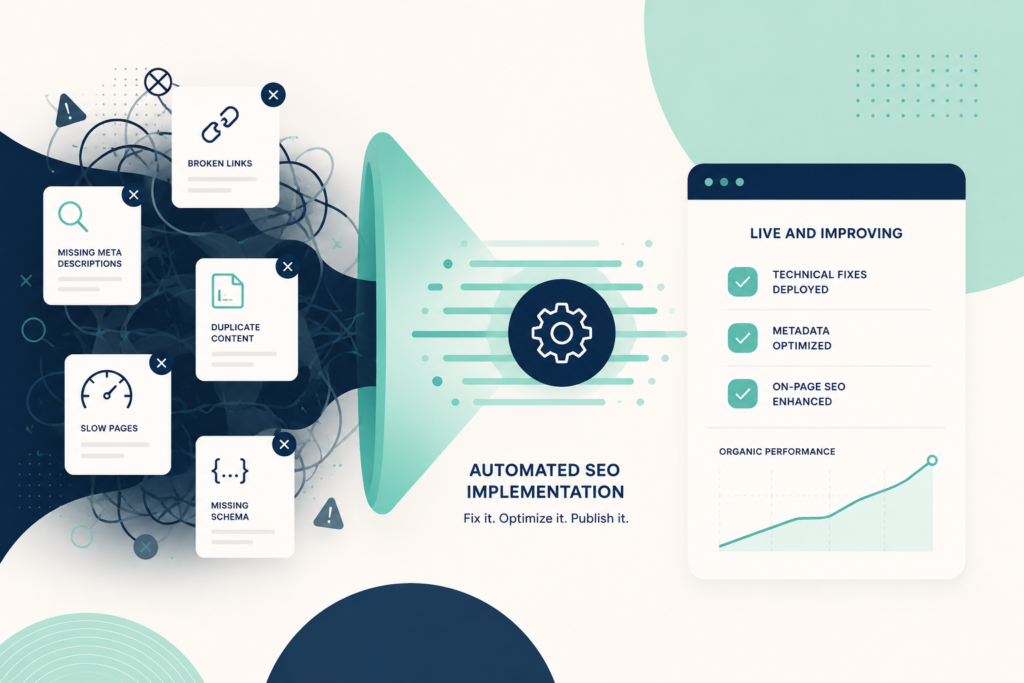
Implementation tools take the next step. They deploy on-page changes, meta data, structured data, internal linking, technical fixes, directly, usually through a code snippet or integration that works across the client’s existing CMS. The agency reviews and approves; the tool ships. The value is not a better report. It is the elimination of the developer queue for the majority of on-page work.
For an agency managing many clients, the second category is where the scaling math changes. If the same platform can apply a change across one client site or fifty, the cost of an additional client drops toward the cost of reviewing and approving, rather than the cost of auditing, ticketing, waiting, and verifying. That is the difference between linear growth, more clients means more staff, and leverage.
Neither category is wrong. A boutique agency doing high-touch strategy for five enterprise clients may need depth of analysis more than deployment speed. An agency trying to serve fifty small and mid-sized clients profitably needs the deployment side, or it will not be profitable. Match the tool to the model.
How to evaluate the best SEO software for agencies
Buying advice for agency SEO tools usually reduces to feature checklists. A longer list looks like more value. It is not a useful way to choose, because every mature tool checks most of the boxes. Evaluate on the dimensions that actually separate them.
What does it implement, not just report? Ask specifically: which changes can the tool deploy without a developer, and which still require one? A tool that deploys meta data, schema, and on-page fixes removes more of the bottleneck than one that only flags them.
Does it work across any CMS? Agencies inherit whatever their clients are running, WordPress, Shopify, Wix, custom builds. A tool that requires a specific platform creates a client you cannot serve efficiently. CMS-agnostic deployment, typically via a code snippet, matters more for an agency than for an in-house team that controls one stack.
How does it handle scale? Can a rule or optimization be applied site-wide and across multiple client accounts from one dashboard? Per-page, per-client manual work does not scale, regardless of how good each individual action is.
Does it keep the agency in control? Automation without approval is a liability when the client’s brand and rankings are on the line. The useful pattern is review-then-deploy: the tool proposes, the agency approves, the change goes live, and any change can be revoked. Look for that control layer.
Is reporting genuinely client-ready? Rankings tracking and progress reporting still matter, both for client trust and for proving the work. The reporting does not have to be the differentiator, but it has to be present and presentable.
This is also the right frame for white label SEO software for agencies. White labeling is valuable, branded dashboards and reports let an agency present the work under its own identity, but it is a presentation layer on top of the capabilities above. A white-label wrapper around a reporting-only tool still leaves the agency with the implementation gap. Evaluate the engine first, then the branding.
A note on SEO agencies serving software companies
One specific case is worth separating out, because the search demand exists and the dynamics differ: an SEO agency for software companies, or for SaaS specifically.
Software clients tend to have large, templated sites, frequent deployments, and in-house developers who are already overloaded shipping product. The implementation gap is often worse here, not because the SEO is harder, but because SEO changes compete directly with the product roadmap for the same engineering time. For agencies in this niche, a tool that ships on-page changes without consuming the client’s developer hours is not a convenience. It is often the only way the work gets done at all.
Where this leaves an agency deciding what to buy
The honest summary is this. The SEO tools market is crowded, and most tools are competent at the part that no longer differentiates anyone: finding problems and reporting on them. The constraint that actually limits an agency’s growth is the work that gets recommended and never shipped, and the tools that address that constraint are a smaller set.
So the question to bring to a demo is not “what can this tool show me?” Every tool can show you plenty. The question is “what can this tool deploy, across any client CMS, with my approval, without a developer?” The answer to that question is what determines whether your agency can take on the next ten clients with the team you already have, or whether you are about to hire your way into the same ceiling one tier up.
That is the calculation worth making before you sign anything.
Häufig gestellte Fragen
What is SEO software for agencies? SEO software for agencies is a platform built to manage search optimization across multiple client sites from one place. The strongest options go beyond auditing and rank tracking to deploy on-page changes directly, so an agency can serve more clients without adding staff for each one.
What should agencies look for when choosing SEO software? Prioritize what the tool can implement, not just report. Key criteria are deployment without a developer, compatibility across any CMS, the ability to apply changes across multiple accounts from one dashboard, an approval step that keeps the agency in control, and client-ready reporting.
How does SEO software help agencies scale without hiring? The cost of an extra client in a manual model is audit hours plus implementation coordination plus reporting. Software that deploys changes across sites collapses much of that into review and approval, so the marginal cost of each new client falls and the team can manage more accounts at the same headcount.
Do AI Overviews change what agencies need from SEO tools? Yes. With AI Overviews reducing click-through rates on affected queries and search results growing more volatile, the speed at which an agency can ship fixes and structured content matters more than before. Tools that shorten the path from recommendation to live change are better suited to this environment than report-only tools.
Can SEO automation replace an agency’s SEO team? No. SEO automation removes repetitive deployment work; it does not replace strategy, judgment, or client relationships. The practical model is automation handling the high-volume on-page implementation while the team focuses on strategy and the decisions that require human judgment.
 German
  English
  Swedish
  French